 HABARLAR
Significant projects in the energy sphere of Turkmenistan
In terms of proven natural gas reserves, Turkmenistan is one of the world's leading countries in hydrocarbon reserves, in particular, it is among the top five countries in terms of natural gas reserves. Today it is one of the main suppliers of blue fuel in the region of Central Asia. Due to its favorable geopolitical position and the richest hydrocarbon deposits, the country has enormous opportunities to increase gas exports in various areas, including European and Asian markets.
Turkmenistan's total potential hydrocarbon resources amount to 71.2 billion tons of equivalent fuel, of which 53 billion tons are in land, and 18.2 billion tons are in sea. The most significant part of these volumes - more than 70% - is natural gas.
As is known, an important aspect of the energy strategy of Turkmenistan is the expansion of the geography of export routes for the supply of Turkmen energy resources to world markets, including through the creation of a multiple transport infrastructure.
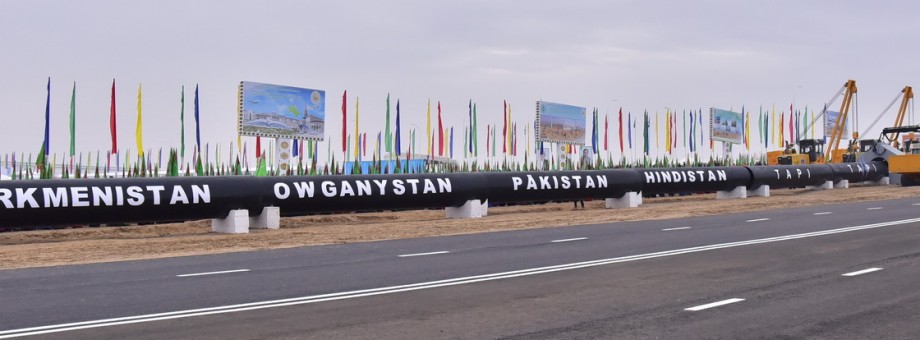
Large-scale investment projects are being implemented in this area, among which a special role is given to the construction of Turkmenistan-Afghanistan-Pakistan-India (TAPI) gas pipeline.
The TAPI project, also known as Trans-Afghanistan Pipeline, is a natural gas pipeline being developed by the consortium “Galkynysh – TAPI Pipeline Company Limited” with participation of the Asian Development Bank. The total length of the TAPI pipeline will be 1814 kilometers - a 214-kilometer section of the pipeline runs through Turkmenistan, a 774-kilometer section will run through Afghanistan and an 826-kilometer section will go through Pakistan.
The project got in the active phase in 2010 by signing in Ashgabat a four-party intergovernmental agreement on this project. Then, from 2012 to 2016, the legal framework of the project was coherently refilled by the Agreements for the purchase and sale of natural gas with all buyers, joint-stock and investment agreements.
In December 2015 the construction of TAPI was started in Mary region, Turkmenistan. The laying of the 214-kilometer section of the gas pipeline in the territory of Turkmenistan was carried out by the State Concern “Turkmengas”.
In February 2018 the construction of the Afghan section of TAPI gas pipeline was started in the Serkhetabad district of Mary region (south-east of Turkmenistan) and the laying of power transmission lines and fiber-optic communication lines on the route Turkmenistan-Afghanistan-Pakistan (TAP) was launched. Together with this, the Serhetabat-Turgundi railway was put into operation. The ceremony was attended by the President of Turkmenistan Gurbanguly Berdimuhamedov, President of the Islamic Republic of Afghanistan Mohammad Ashraf Ghani, Prime Minister of the Islamic Republic of Pakistan Shahid Hakan Abbasi and State Minister for External Affairs of the Republic of India Mubashir Javed Akbar.
The project includes comprehensive works on the design, procurement, construction, operation and maintenance of the 1814 km pipeline from Turkmenistan to Afghanistan, Pakistan and India.
It is envisaged that after full commissioning of TAPI, that within 30 years up to 33 billion cubic meters of natural gas per year will be exported along the route from Galkynysh, the world’s second-biggest gas field, to Fazilka near the border with Pakistan in northern India.
India and Pakistan each would buy around 14 billion cubic meters and the remaining 5 billion will be going to Afghanistan.
Along with the increase in oil and gas production, the creation of a multi-vector system of transporting Turkmen energy resources to world markets, great attention is paid to the diversification of the oil and gas industry, the construction of large industrial facilities specializing in the processing of hydrocarbon raw materials, including those in the petrochemical, gas and chemical industries and electric power.
For this purpose, the cooperation with the foreign companies becomes stronger.
In this regard, the share of foreign investment in the Turkmen economy is growing steadily, the number of investment projects and joint ventures is increasing.
Among the leading business partners of Turkmenistan is the “Chinese National Oil and Gas Corporation” (CNPC), which since 2007 has been exploring, developing and developing the fields that are part of the Bagtyyarlyk contract area, which serves as the raw material base of the Turkmenistan-China transnational gas pipeline. This power line was put into operation in December 2009. According to interstate agreements, 65 billion cubic meters of Turkmen natural gas will be delivered to China in the near future through this gas pipeline.
Among the other major investment projects implemented jointly with “CNPC” and “PetroChina” is the construction of the Galkynysh deposit, which is one of the largest in the world in resource reserves estimated at 26.2 trillion cubic meters of gas. The capacity of the complex of plants for the preparation of commercial gas is 30 billion cubic meters of natural gas per year. In accordance with the contract concluded with the State Concern “Turkmengaz”, CNPC is building a second complex of commercial gas production facilities at the field in the amount of 30 billion cubic meters per year.
The partnership with other leading states of the Asia-Pacific region is developing. In October 2015, within the framework of the official visit of Japanese Prime Minister Shinzo Abe to Ashgabat, a large package of agreements was signed with representatives of Japanese business and financial circles, envisaging the implementation of joint projects worth over 18 billion US dollars. In their number - projects of construction of a gas processing complex for production of linear polyethylene of low pressure from ethylene; a plant for the production of liquid fuels from natural gas based on Japanese technology GTL; a plant for processing gas into polymers; objects in the development of the gas field "Galkynysh."
To this end, investments in the amount of about 8 billion USD were invested in the industrial development of the Galkynysh gas field.
In addition, a contract was concluded between the State Concern Turkmengaz and the consortium of LG International Corp., Hyundai Engineering Co., Republic of Korea and Itochu Corporation (Japan) for the construction of a plant for the production of synthetic liquid fuel in the Akhal Velayat by processing natural gas, as well as the Framework Agreement for the construction of a "turn-key" plant for the production of polyethylene and polypropylene with the installation of ethane cracking in the Dashoguz velayat.
A number of projects related to gas processing are planned to be implemented in the chemical industry and power engineering, including the construction of a complex for the production of concentrated phosphate fertilizers at the Turkmenabat chemical plant and 432 MWt (ISO) gas turbine power station in the Serdarabat district of the Lebap velayat.
In June 2018, at the Turkmenbashi complex of oil refineries, the plant for the production of polypropylene film was commissioned. The contract for the construction of a plant for the production of packaging film of two types - transparent single-layer and co-extrusion film was concluded with the company "P.T.Istana karang Laut" (Indonesia).
The total cost of this project is about 31 million 700 thousand euros. The annual capacity of the process line mounted at the plant is 21 thousand tons of bios oriented polypropylene film (BOPP).
Recently, on October 17, 2018, in the village of Kiyanly, a gas chemical complex - Polymer plant was launched on the coast of the Caspian sea with the participation of the President of Turkmenistan Gurbanguly Berdimuhamedov.
The plant is capable of processing 5 billion cubic meters of natural gas and producing 386,000 tons of polyethylene and 81,000 tons of polypropylene. The project was implemented jointly with a consortium of companies "TOYO Engineering" (Japan), "LG International Corporation" and "Hyundai Engineering Corp." Ltd (Republic of Korea). Its total value is more than 3.4 billion US dollars. Danish company “Haldor Topsoe”, Italian company license “Saipem”, German company license “Uhde Fertilizer Technology” were involved in this project.
The plant will satisfy requests on the world market in oil and gas sector, also will increase Turkmenistan’s export potential. The construction of this plant is another step towards making Turkmenistan highly industrialized state.
Also, construction of a plant for the production of an A-92 gasoline from natural gas in the town of Ovadandepe of the Akhal province is underway. The complex is being built by the joint efforts of the State Concern Turkmengaz and the consortium of companies Kawasaki Heavy Industries Ltd. (Japan) and Rönesans Endüstri Tesisleri Inşaat Sanaıi ve Ticaret A.Ş. (Turkey). The plant will be put into operation by the end of 2018.
The plant, equipped with the latest equipment and advanced technologies from world famous manufacturers, including the Danish company “Haldor Topsoe”, will be able to process annually 1 billion 785 million cubic meters of "blue fuel" and produce 600 thousand tons of gasoline A-92, high ecological requirements for the Euro-5 standard. It is also planned to produce 12 thousand tons of diesel fuel and 115 thousand tons of liquefied gas per year.
Under the terms of the Production Sharing Agreements, a number of well-known international companies operate in Turkmenistan. In the Turkmen sector of the Caspian Sea, whose total reserves are estimated by experts at 18.2 billion tons of equivalent fuel, “Dragon Oil” (United Arab Emirates) has been working for many years, developing fields that are part of the Cheleken contract area. The company - "Petronas Charigali" (Malaysia) is developing the Caspian fields that are part of the contract area "Block-1".
A solid experience of cooperation in the oil and gas sector has also been accumulated with the companies ENI S.P.A. (Italy), Mitro International Limited (Austria), RWE (Germany) and others.
Turkmenistan is gradually moving towards a “green economy”. The construction uses environmentally friendly and energy-saving modern technologies.
In March 2017, the Garlyk Mining and Processing Plant for the production of potassium fertilizers was commissioned. The construction was commissioned by the State Concern "Turkmenkhimiya" by the joint stock company "Belgorkhimprom" jointly with the Turkmen builders, the complex is designed to produce 1 million 400 thousand tons of fertilizers per year.
The total value of the contract is 1 billion 126 million US dollars. The project is financed from own funds of GC "Turkmenhimiya" (20 %) and domestic bank loans (80 %). The cost of imported equipment is 379 million US dollars.
An ammonia production plant with an annual capacity of 400 thousand tons and carbamide with a capacity of 640 thousand tons per year was commissioned in the city of Mary, in frames of signed contract between State Concern “Turkmenhimiya” and Japan's Kawasaki Plant Systems and Sojitz Corporation.
In the city of Garabogaz, together with Japanese and Turkish companies, the construction of a plant for the production of urea was completed with a capacity of 1.155 million tons of products per year.
At present, work is underway at an accelerated pace on the construction of a number of enterprises for the production of iodine, bromine and products from them. As a result, the volume of production of technical iodine will increase significantly.
Large-scale transformations are also being implemented in the construction industry, in which innovative materials and energy-saving modern technologies are widely used.
In February 2018, the glass producing enterprise was commissioned in the Ovadandepe town of the Akhal region. The project was implemented by the Turkish “Tepe Turkmen Insaat ve Ticaret Anonim Sirketi” company.
The enterprise with a production capacity of 7.2 million square meters of glass produces transparent and tinted, laminated and tempered glass for the manufacture of windows, bottle containers for the food industry and the medical industry.
Production is based on local raw materials: quartz sand, dolomite, limestone and other components.
In this aspect, large-scale investment projects implemented in recent years, can be viewed as the contribution of Turkmenistan to the development of international energy cooperation. This, in turn, has a positive impact on the overall situation and progress in the Central Asian region, turning it into one of the energy centers of global importance.